Premium marketing used to cost a fortune. Now it costs almost nothing.
 Sharbel Safyi, CEO·May 5, 2026
For most of marketing history, the cutting edge belonged to whoever could afford it. The automation that runs campaigns while you sleep, the systems that watch the data and optimize on their own, the research that used to take a quarter: big corporations have been quietly using all of it for years. What changed, and changed fast, is that the same power now sits on a shelf anyone can reach. For the first time, a business of one can run marketing that used to need a department.
What the big companies were actually buying
Strip a large marketing budget down to its most valuable part and you do not find a clever campaign. You find automation. The machine runs, data comes in, and your job shifts from doing the work to optimizing it. That loop, set up once and improving continuously, is where the real leverage lives. Enterprises worked this out decades ago, which is why "marketing automation" has been a line item in big-company budgets since long before AI was a headline. It is unglamorous, and it is the most powerful thing you can invest in.
Three places automation has quietly run marketing for years
Start with email, the least glamorous channel and one of the most automated. The part of email that actually performs is not the newsletter you blast on Tuesday, it is the triggered messages that fire on their own: a welcome series, an abandoned-cart nudge, a win-back. In Omnisend's analysis, automated emails drove 37% of all email sales from just 2% of the sends, earning $2.87 per email against $0.18 for a one-off campaign. You build the triggers once, and the system sends the right message at the right moment forever.
Then take research, the part that used to be slowest and most expensive. Custom market research traditionally meant months of work and a budget to match, which is why small companies simply went without it. AI collapsed that. Tools now simulate customer responses and surface patterns in a fraction of the time, which Harvard Business Review describes as dramatically reducing the time and cost of traditional research. The work that once gated a launch behind a research firm now runs in an afternoon.
And take advertising at scale, where automation is now the default rather than the exception. Most digital ads are no longer bought by a person negotiating placements, they are bought by software in real-time auctions that decide, impression by impression, who to show an ad to and how much to bid. Over 90% of US digital display advertising is now bought programmatically. A system spends the budget, reads the results, and reallocates at a speed no human team could match.
In every case the shape is the same: stand up a system, let data flow in, and spend your time optimizing instead of executing. That is the real prize of investing in marketing, and it is exactly what stayed out of reach for everyone but the enterprise.
The barrier was never the technology. It was the price of access.
Here is the part that just changed. None of this was secret. The models, the automation, the analytics were all available, if you could pay for the software licenses, the data team, and the specialists to wire it together. That cost is what kept it inside big companies, not some hidden knowledge. AI knocked the price of access down to almost nothing, and the capability spilled out to everyone at once. Small businesses moved fast: in SBE Council's 2026 survey, 82% of small employers had already invested in AI tools. For the first time, maybe in history, the smallest business can use the same cutting-edge marketing technology as the largest.
The trade-off every strategy class teaches, and the one we just broke
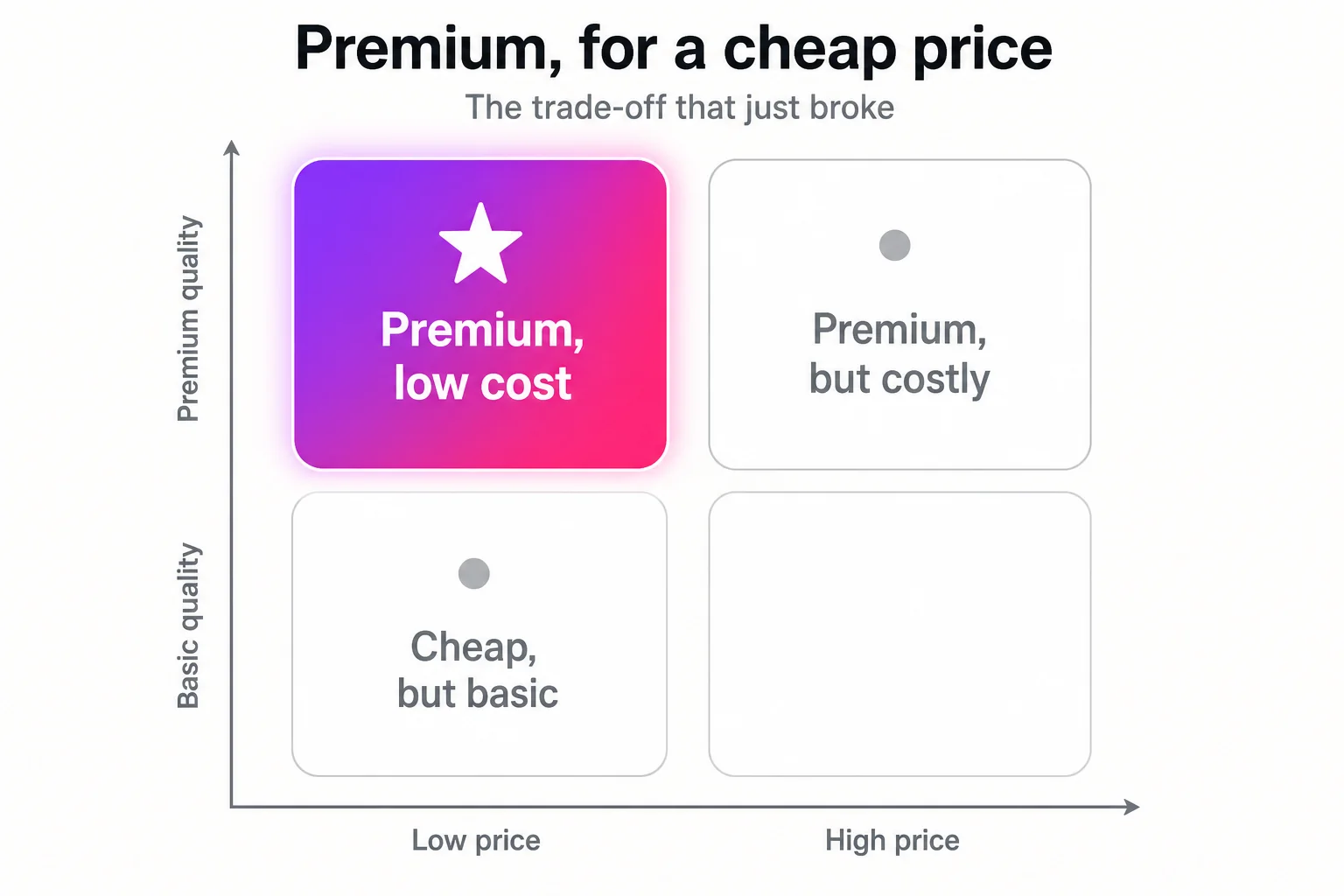
There is a rule drilled into every business student. Michael Porter's classic framework says you essentially pick one of two ways to win: be the cheapest, or be the best. Try to do both at once and you end up "stuck in the middle" with no real advantage. MBA programs even teach it through a simulation called Markstrat, a marketing strategy game played at over 500 schools, including 8 of the top 10 international business schools, where you steer a company round after round and learn, quickly, that you cannot be premium and cheap at the same time. Pick a lane.
What is happening now breaks that rule, and I do not say that lightly. For the first time I can point to, you can get the premium option at basically the low-cost price. The expensive thing, enterprise-grade automation, brand-aware content, research on demand, is being delivered for the price of the cheap thing. The trade-off that strategy classes treat as a law of nature just stopped applying to this corner of the market.
How premium-for-cheap actually works
The way that becomes real is unglamorous: someone does the wiring for you. The reason premium marketing was expensive was never only the software, it was the assembly, the specialists connecting the models, the data, the channels, and the brand rules into something that runs on its own. Tools like Marvin take that entire backend and automate it, so the parts that used to need a team are handled. What is left for you is the one thing only you can do: describe what you want. At most.
That is also what separates this from just opening a chatbot. Raw AI hands everyone the same flat, average output, so getting a premium result still takes a layer on top: your brand, your voice, and the best practices baked in and kept current. The shift is that you no longer have to build or maintain that layer yourself. It comes set up, the same way we argue you should build the engine before the strategy.
The window is open, and being early is the advantage
If you run a small or medium business, this is the best moment you have had. The marketing machinery that used to belong to companies with national budgets is now a subscription, and the gap between you and them is the smallest it has ever been. But that gap will not stay open evenly. The advantage goes to the people who adopt this now and stay active in the shift, the ones learning to point these tools at their own business while everyone else is still deciding whether AI is real.
Premium used to be something you saved up for. Now it is something you switch on. If you want to see what enterprise-grade marketing looks like at a small-business price, that is what Marvin is for.
Frequently asked
- Why could only big companies afford advanced marketing before?
- Because the value was in automation, and the automation needed expensive software licenses, a data team, and specialists to assemble and run it. The technology existed, but the cost of access, not the technology itself, kept it inside large companies. AI brought that cost of access down far enough that a small business can now reach the same capability.
- What are examples of automation in marketing?
- Three common ones: triggered email flows like welcome and abandoned-cart series, which drive most email revenue from a tiny share of sends; programmatic advertising, where software buys ads in real-time auctions and now accounts for over 90% of US digital display; and AI market research that simulates customer responses to cut research time and cost. Each runs on its own while you focus on optimizing it.
- Is cutting-edge AI marketing actually affordable for a small business now?
- Yes, and that is the change. The cost of access has fallen sharply, and most small businesses have already started investing in AI tools. Platforms like Marvin automate the setup that used to require a team, so you get enterprise-grade marketing for a small monthly cost instead of an enterprise budget.
- What does "premium for a low cost" mean?
- Business strategy normally forces a choice between being cheap and being the best, what Porter called avoiding "stuck in the middle." For the first time, software delivers the premium option, automated and brand-aware marketing, at close to the low-cost price. That breaks the usual trade-off for any small business that adopts it.